
“Know thyself” was one of the maxims associated with the Temple of Apollo at Delphi, and the question of self-knowledge has continued to occupy philosophers and spiritual traditions for centuries.
I personally believe it is an unfolding journey for all of us. Some people consciously embrace this enquiry on a daily basis, while for others it might emerge only sporadically, often brought forward by major events in life.
I recently had the opportunity to visit Dev-Aura in England to attend an Aura-Soma Teacher Update Course, and the experience gave me another opportunity to explore this question.
I didn’t leave Australia thinking I was going to find myself, nor did I return with a completely new sense of who I am, yet something shifted. Perhaps what changed was not how much I know myself, but my certainty about how completely I can ever know myself.
It was my first time at Dev-Aura, so I consciously kept my expectations in check and allowed my sense of wonder and discovery to take centre stage. The curiosity about finally seeing and experiencing a place I had heard so much about over the years was palpable.
Dev-Aura is a place of learning and reflection, closely connected with the development of Aura-Soma through its founder, Vicky Wall, and Mike Booth. The entire space feels carefully curated, and I was lucky enough to experience warm, dry weather while I was there, adding a kaleidoscope of colours and feelings that the usual rainy England would probably have changed.
I didn’t join the course with the intention of discovering parts of myself; however, one thing I have learned from attending Aura-Soma courses is that somehow you always end up learning something about yourself.
At the beginning of each day, we made a four-bottle selection and worked with the colours we chose.
The principle that you are the colours you choose sits at the heart of the Aura-Soma system, but for me this does not mean that the bottles tell us who we are. I experience them more as a reflection of our inner landscape.
Some areas of that landscape are clear and familiar because we have walked through them many times, while others seem darker and more mysterious, not necessarily because there is something wrong with them, but simply because the light of our awareness has not reached them yet.
Perhaps this is also why application becomes important. Selecting the bottles can bring something into view, but experiencing them allows us to become curious about what we cannot yet understand, gradually bringing the light of awareness into those areas of ourselves that remain less familiar.
The Layers We Know
We only come to a perception of ourselves through what we have been able, or perhaps felt safe enough, to bring forward, and while life continuously offers opportunities to know ourselves more deeply, I am beginning to wonder whether reaching the absolute core is even possible.
Often, we trust our thinking mind, while at other times we are guided by our feelings. Both are important parts of ourselves, but I don’t believe they are the full recipe; there is also something instinctual, often unconscious, which seems to hold the reins and point us towards one direction or another.
The more I experienced Dev-Aura, the more I noticed how carefully the environment itself seemed to support this enquiry.
My favourite place was the gardens. Three distinct spaces represent what within Aura-Soma are described as the three levels of being: thinking, feeling and instinctual. At the end is Vicky’s garden, with an enormous tree overlooking the space.
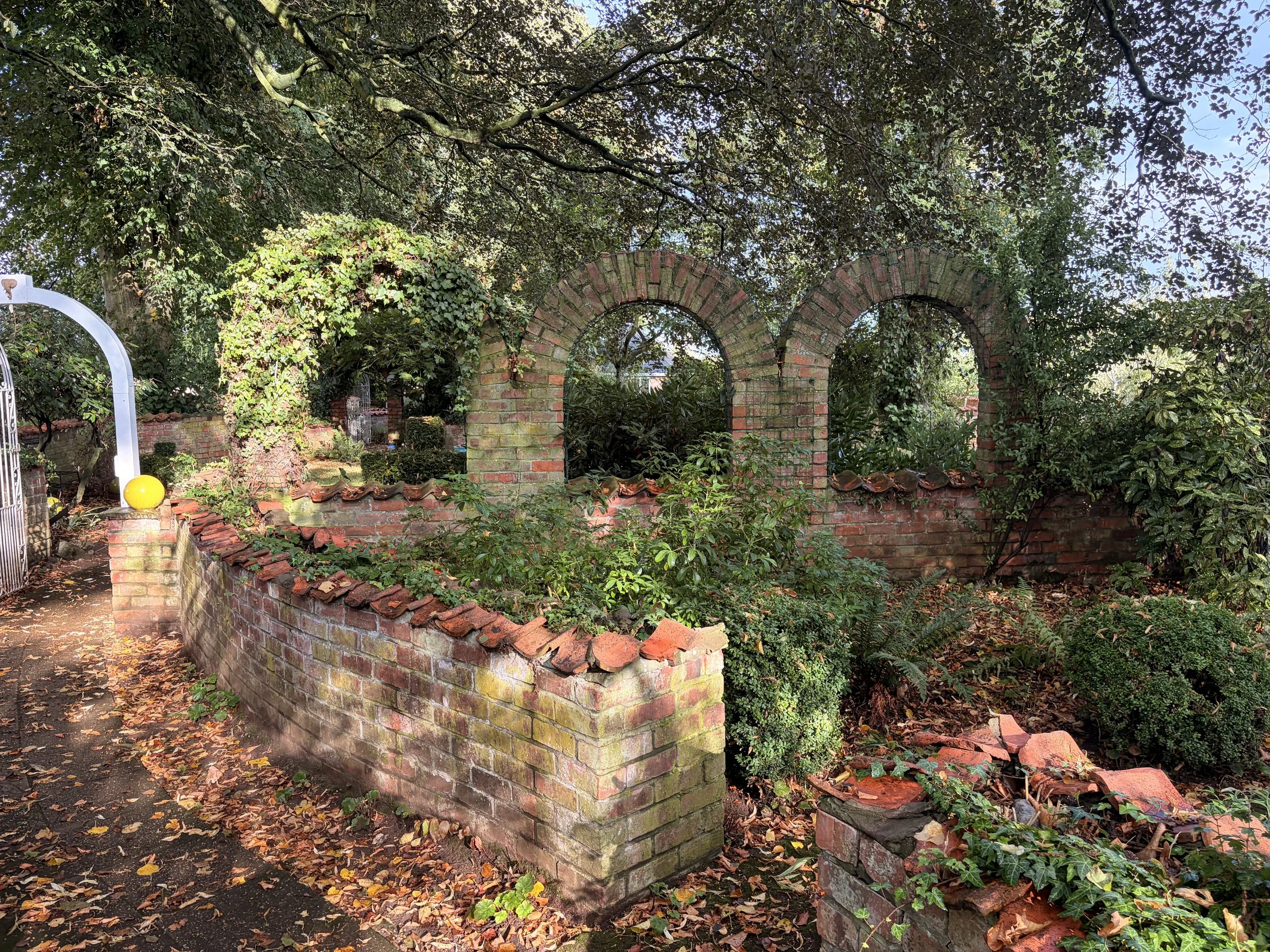
As I meditated in the gardens, I realised that thinking might be the easiest layer for me to face. Even though not all our thoughts are conscious, thinking feels familiar because we have words for our thoughts; we can analyse them, challenge them, explain them and arrange them into something that makes sense.
Descartes famously wrote, Cogito, ergo sum — “I think, therefore I am.”
Yet what I know is that thinking cannot be the whole of who I am.
Feelings were also surfacing from depths I wasn’t necessarily aware of, and while I wasn’t discarding them, at the same time I wasn’t fully understanding them either.
How often do we allow ourselves to be defined by what we feel?
Even our language reinforces this identification when we say I am sad. I am happy. I am in love. Perhaps I am experiencing sadness, I am experiencing happiness or I am experiencing love tells a subtly different story, where the feeling belongs to our experience without necessarily representing the entirety of who we are.
And then there is the instinctual, which is where my enquiry became considerably less comfortable.
The Self We Have Learned
What we have “learned” about ourselves over the years can easily become something we believe to be the full and finite story, yet learning who we are does not happen in isolation.
We learn ourselves through relationships, family, society and experience, and somewhere along the way we also learn which parts of ourselves seem to bring acceptance and which parts appear to threaten it.
There is a sense of safety in belonging. We all want, in one form or another, to experience love and acceptance, and perhaps along the way we begin filtering ourselves in order to preserve them.
This doesn’t necessarily make the person we become false. The roles we occupy can be very real, and our actions and behaviours substantiate them. I am a teacher because I teach; I am a practitioner because I practise, and there are many other roles through which I can logically describe myself.
Yet increasingly I feel that trying to contain the entirety of who we are within those definitions is like squeezing something big into a small jar. The jar might accurately describe the shape we are taking at that particular moment, but it cannot necessarily contain our essence.
During the course I found myself acting, and sometimes being called to act, in ways that felt profoundly me, even though somewhere within myself I had previously decided that some of those expressions were not possible.
I said things I felt I needed to say, asked questions I wanted to ask and allowed myself to respond to the experience as it unfolded. At the end of the course, I remember saying that I was leaving without regrets, without the usual I wish I had said that, I wish I had asked that or I wish I had done that.
Perhaps for a short time the need to understand whether I was expressing myself in the “right” way became less important than simply allowing myself to move.
What Am I Here to Do?
One of the most significant moments came during a consultation with Mike Booth, when he used my second-day bottle selection as an example for the group and, while exploring it, asked me what I was here to do.
I didn’t have an answer.
In the past, I probably would have tried to find one by looking towards a role, a profession or something I could define and eventually make mine, because there is comfort in being able to say, This is who I am and this is what I am here to do.
This time, however, I couldn’t do that. All I could say was that I could try to be as present as possible and allow life to show me what I am meant to do.
There was something strangely freeing in not knowing.
Perhaps my purpose does not need another job description, and perhaps presence is what allows the next step to become visible. At times the clues seem subtle; at other times they are clearer, appearing through a conversation, an unexpected coincidence or something within the natural world that suddenly catches our attention.
Whatever form those moments take, we can only notice them when we are present enough to listen, and perhaps listening is becoming more important to me than finding the answer.
Red
Throughout the course, red became the predominant colour within my selections.
This was particularly interesting because red wasn’t new territory for me. Before travelling to Dev-Aura, I had already spent considerable time reflecting on red and had written about it as an expression of duality: the physical experience of life, movement, belonging, manifestation and liberation, and the possibility of apparently opposing currents eventually finding integration.
Yet there is another relationship with red that goes much further back.
As a child, red was my favourite colour.
Somewhere along the way that changed, and for much of my adult life I would not have described myself as particularly drawn to red. I cannot know whether the layers that naturally developed as I grew — the layers through which we learn to belong, protect ourselves, seek acceptance and receive love — somehow concealed something that had once been much more naturally expressed.
But I find it fascinating that red is now coming to the surface again.
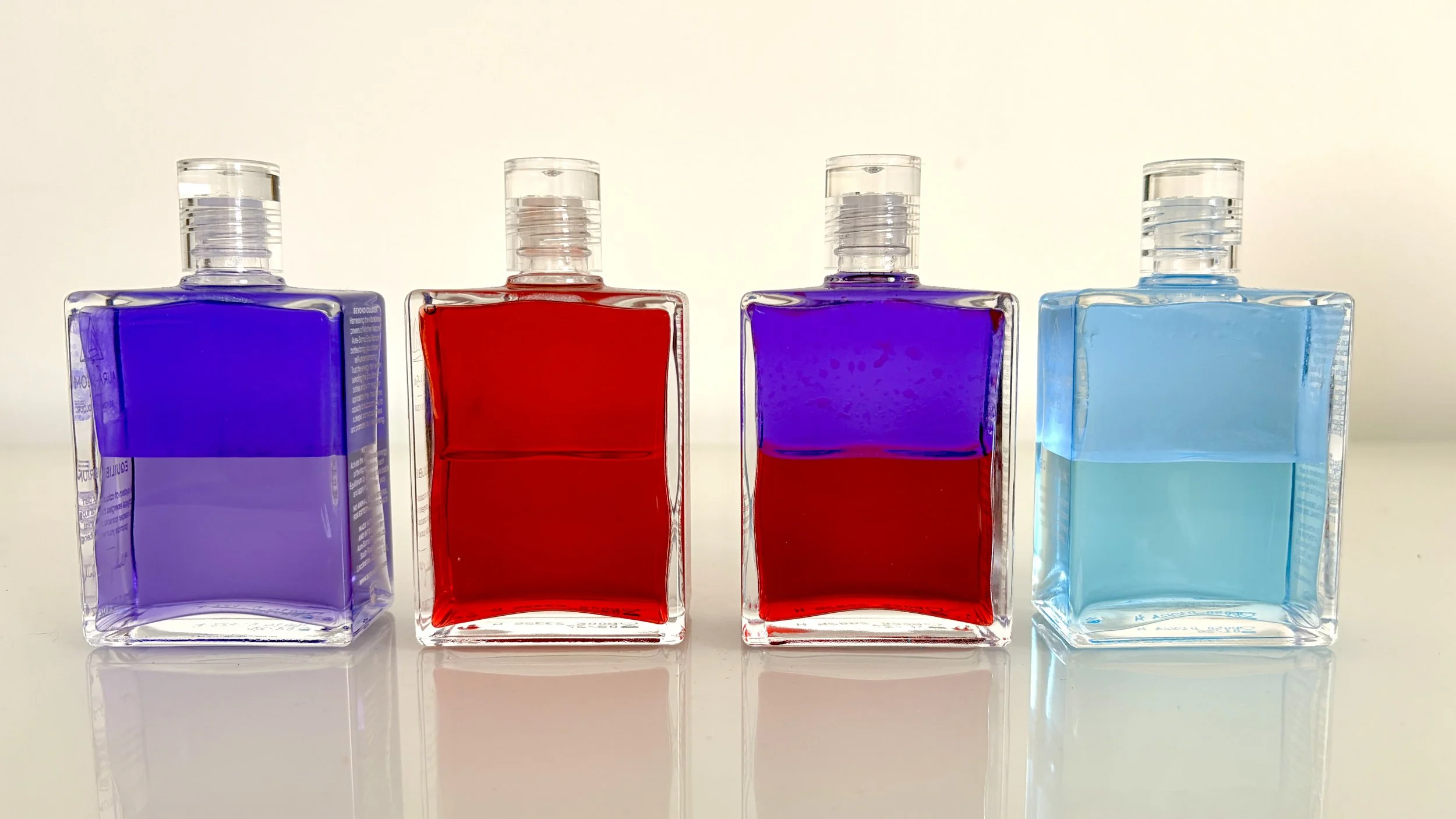
Perhaps some of the darker areas of our inner landscape are not parts of ourselves that we have never known at all. Maybe some are aspects we once expressed naturally, before we had the language to define them and before life taught us which parts of ourselves felt safest to bring forward.
During my consultation, Mike also invited me to restore my feminine side and embrace it, and this is perhaps where the experience becomes even more mysterious for me.
I understand masculine and feminine conceptually, and I can identify what I perceive as my masculine and feminine sides, yet I am beginning to realise that they don’t necessarily communicate with each other. At times, it feels as though they alternate themselves on the stage of life: one comes forward and performs its part before eventually giving way to the other.
What would happen if they no longer needed to alternate?
I don’t know, but I feel that red may become part of exploring the union of the two.
For me, red carries an enormous potential for movement, yet movement can become suffocated by our need to belong, to feel safe, to be accepted and to be loved. Maybe some of the limits we experience are boundaries we once created because they helped us remain safe and connected; they may have served us beautifully, but that does not necessarily mean that we still need them in the same way.
Perhaps this is why the return of red feels less like the discovery of something new and more like the recognition of something familiar.
You Are the Colours You Choose
Reflecting on my selections from Dev-Aura, I can see that I selected a message for myself that goes deeper than I initially expected, and I still cannot completely understand it.
Curiosity and rejection are equally present, and perhaps they need to be.
When we approach an Aura-Soma selection, there is an enormous body of knowledge available about colours, numbers and the individual Equilibrium bottles, and as a practitioner and teacher I have learned much of it. Yet when I sit in front of the bottles to make my own selection, perhaps the most useful thing I can do is temporarily forget what I know and allow the attraction to come first.
For me, the bottles reflect ourselves back to ourselves through the colours we feel drawn towards, offering a snapshot of an inner landscape at a particular point in our journey.
But a snapshot cannot show us everything.
Some parts are brightly illuminated while others remain in shadow, and this is where I feel the experience begins. Through application, we have the opportunity to live with what we have selected rather than simply interpret it, allowing awareness to gradually enter those darker and more mysterious areas of the landscape.
I have not done enough of that yet to know what my selections are ultimately asking me to see, and I don’t want to rush the answer.
Do We Really Know Ourselves?
I returned from Dev-Aura with a level of respect for Aura-Soma that only the direct experience of being there could have given me, and experiencing Dev-Aura and Shire Farm also gave me a stronger sense of authenticity that I know will find its way into my consultations and teaching.
But perhaps the most valuable thing I brought home was another question.
Do I really know myself?
I think I know layers of myself. I know the roles I have lived, many of my thoughts and feelings, patterns, behaviours, strengths and limitations; I can identify qualities that feel masculine or feminine to me, and I can recognise those moments when something feels profoundly me.
But I don’t think I know the full depth of myself, because perhaps that depth cannot be disclosed through thinking alone and can only emerge through the experience of life itself.
Somewhere within me, I believe my soul already knows exactly what it is here to do. The challenge might not be to find another way of defining it, but to stop trying so hard to hear it and finally learn how to listen.
For now, red is part of that enquiry. Perhaps it will bring movement, perhaps it will illuminate another part of the landscape, or perhaps the masculine and feminine sides I currently experience taking turns on the stage will eventually learn how to stand there together.
I don’t know yet, and for once I don’t feel that I need to.
Perhaps knowing ourselves is not about reaching a final definition of who we are, but remaining present enough for life to gradually disclose the depths we have not yet experienced.
And perhaps, somewhere within those depths, red has been waiting for me all along.

Continue Exploring Aura-Soma
If this reflection has made you curious about colour, self-selection and the way Aura-Soma can support a deeper relationship with yourself, explore the Aura-Soma Pathway at Ynot Crystals.